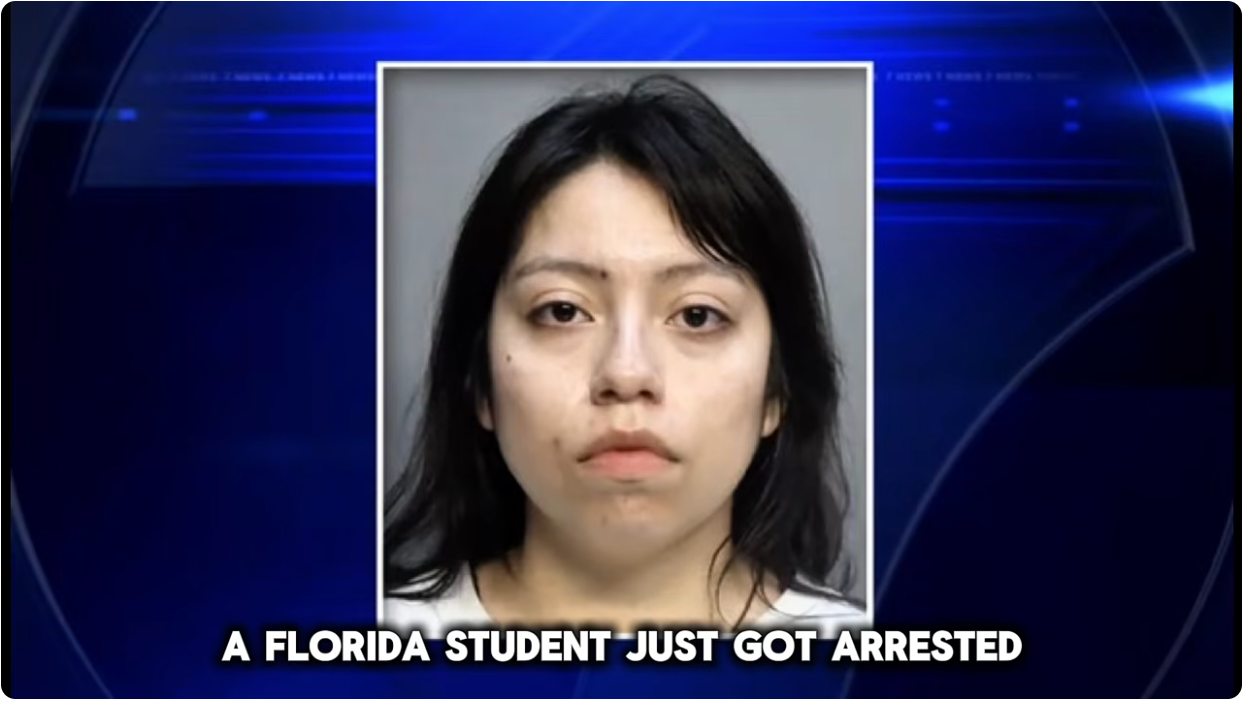
This narrative has a really frightening quality, and it’s unclear exactly who the antagonist is. A 23-year-old Miami college student sent a caustic post in a group chat, disgruntled by finals week and terrified of a required capstone project. She demanded that Benjamin Netanyahu “drop some bonbons” on the convention centre at her institution. She was booked into a prison a few days later and faced a possible 15-year term. The entire scenario had the air of a dark satire book, yet Gabriela Saldana is a real person whose life might never be the same, and it took place in a real parking garage on 8th Street and 109th Avenue.
The post itself, which was delivered to a WhatsApp group of about 215 other Florida International University capstone students, clearly bears the mark of student humour. It’s the kind of stuff you type on impulse at 11 p.m. after three terrible cups of coffee, half expecting a laughing emoji in response.
“Netanyahu, if you can hear me, drop some bonbons for us Capstone students in Ocean Bank Convocation Centre.” It is ludicrous. It has political overtones. It alludes to a foreign head of state who is completely unrelated to FIU’s academic schedule. And in the weary logic of it all, it almost makes sense: bonbons, not bombs, yet officials deduced that the term was code for explosives.
The question that hangs over the entire case is whether such a view is fair or a major overreach. Later, Saldana added a second letter that mentioned “a bomb in the Ocean Bank Convocation Centre” and placed the blame on another student named Jonathan. This message alone seems even more concerning. As if the emoji could make everything better, she added “I sowwy:.” to the original message.
It was unable to. The machinery moved quickly as other students in the discussion reported her to the university police. The FBI’s Joint Terrorism Task Force became engaged. They brought in the Miami-Dade State Attorney’s Office. Depending on your point of view, the response was either suitably detailed or wildly out of scale for a late-night joke written by someone who was terrified about exams.
Saldana was taken into custody next to a parking structure on the Modesto Maidique campus of FIU. She didn’t fight back. She acknowledged sending the emails. She informed the cops that it was a joke, a “dumb joke” in her own words, and that she was expressing her annoyance and perhaps hoping that the event would be rescheduled. There’s no way to know if she said that out of icy astonishment at being handcuffed or because she truly believed it. She was brought to the Turner Guilford Knight Correctional Centre and charged with a second-degree felony, which is a written threat to murder or cause bodily damage.
Key Information: Gabriela Saldana & The FIU WhatsApp Case
| Detail | Information |
|---|---|
| Full Name | Gabriela Saldana |
| Age | 23 years old |
| University | Florida International University (FIU) |
| Incident Date | April 10, 2026 (event date); arrested April 16, 2026 |
| Platform | WhatsApp group chat (~215 students) |
| Message Sent | “Netanyahu, if you can hear me, drop some bonbons for us Capstone students in Ocean Bank Convocation Center” |
| Charge | Written threat to kill or do bodily harm (Second-degree felony) |
| Potential Sentence | Up to 15 years in prison |
| Bond Set | $5,000 |
| Presiding Judge | Judge Mindy Glazer |
| Agencies Involved | FIU Police, FBI’s Joint Terrorism Task Force, Miami-Dade State Attorney’s Office |
| Booking Location | Turner Guilford Knight Correctional Center |
Judge Mindy Glazer didn’t exactly come off as uncaring at her bail hearing. She accepted the joking defence. However, she also highlighted a clear distinction, noting that the communication could be interpreted as a genuine threat by an impartial observer, sufficient to establish probable cause.
Glazer stated bluntly, “I’m not saying it’s enough for beyond a reasonable doubt,” indicating that she was aware that this case wasn’t definitive. “I don’t know if the state is going to be able to prove it at trial.” That’s a noteworthy acknowledgement from a judge who set bail at $5,000. The prosecution may have significant difficulties in this case. It’s also conceivable that the case goes well beyond what anyone is currently anticipating.
It is hard to disregard the political environment and the moment. Any mention of Netanyahu, whether genuine, sarcastic, or utterly ridiculous, now has a different weight in American public life than it could have five years ago due to the Gaza crisis. There have been flashpoints at universities all around the nation.
Administrators, law enforcement, and courts are navigating uncharted territory amid tensions between university free-speech traditions and post-October 7 sensitivities. Even in its absurdity, Saldana’s message found its way into that tense environment. It’s difficult to tell with certainty if that circumstance increased the likelihood of her detention, but it’s difficult not to wonder.
The question of what constitutes a “true threat” under the law and the precise boundary between student annoyance and criminal intent is being discussed more broadly. In several cases, courts have struggled with this difference, and social media has further complicated the issue.
Not only is a message written to 215 members of a restricted student club not a public manifesto, but it’s also not a whisper between friends. It occupied that murky digital middle ground where context may be readily removed and tone is imperceptible. According to reports, the Foundation for Individual Rights and Expression, which monitors school free speech issues, has taken note, suggesting that this case may extend beyond Saldana’s particular situation.
She waits for now. Gabriela Saldana has already experienced something that most college students can hardly fathom: being arrested for a WhatsApp message, going through the prison system, and becoming the focus of worldwide media attention.
The joke about bonbons has been reported in the United States, the Middle East, India, and the United Kingdom. That reach has a certain terrible irony. She desired to leave a capstone event. She became the focal point of a national dialogue on speech, security, and the peculiar, paranoid state of affairs that America is presently experiencing.
It’s difficult to avoid the impression that something has gone a little wrong here, even while it’s still really unclear what went wrong and who is to blame.